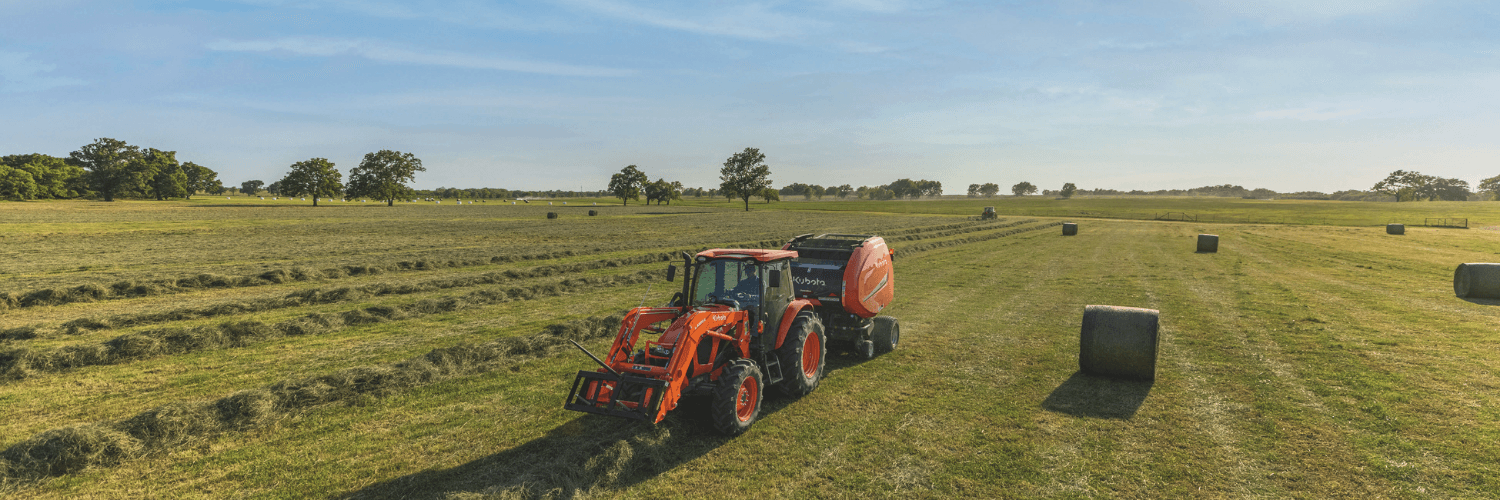


How to Choose the Right Tractor for Hay Production (Without Buying Too Much, or Not Enough)
4/4/2026

Hay season has a way of making small problems feel big. A forecast shifts, a belt squeals, and a tractor that looked fine on paper suddenly feels underpowered, too light, or just plain tired.
We see it all the time in Northeast and Eastern Ohio: folks buy a tractor based on a deal, a neighbor’s opinion, or a horsepower number that does not match the baler. Then the first breakdown or stuck-in-the-field moment turns into lost time, missed cutting windows, and a reputation hit if you are selling hay.
This guide is how we help customers pick the right tractor for hay production. Straight answers, no runaround. We will walk through sizing, tractor horsepower for hay equipment, stability for handling bales, and the support pieces that keep you running once the grass is down.
Start with the hay tools, not the paint color
The best tractor for hay production is the one that matches your implements and your pace. Start here: what are you actually going to pull and run?
Make a list: cut, dry, rake, bale, move
Most hay setups include:
Write down your implement brands and model numbers if you know them. If you do not, at least note width and bale type. The baler drives the tractor choice more than most people expect.
The two numbers that matter most: PTO horsepower and tractor weight
For hay work, two specs keep you out of trouble:
- PTO horsepower, because your mower and baler run off the PTO
- Tractor weight, because bales and hills do not care about brochure horsepower
A lighter tractor can have enough PTO HP and still be the wrong machine if it feels squirrely with a loader and a round bale. On the flip side, a heavier tractor with the right PTO HP will usually feel calmer, safer, and less stressed.
What size tractor for hay production: a practical sizing map
“What size tractor for hay production” depends on bale type, field conditions, and how fast you need to work. Here is a no-nonsense map we use to get close, then we fine-tune based on your exact implements.
Small square bales and lighter implements (typical part-time hay)
If you are cutting moderate acreage, making small squares, and using lighter gear, many operations land in the 35 to 60 PTO HP range.
That covers a lot of:
- 7 to 9 foot haybines or smaller disc mowers
- Most tedders and rakes
- Small square balers in average hay
Handling can still be the limiting factor. If you are stacking wagons or moving bales with a loader, tractor weight and loader capacity matter as much as the PTO number.
Round bales and modern hay equipment (where most people undersize)
If you are making round bales, plan on a larger margin. For many baler setups, the tractor that “can” run it is not the tractor that runs it all day without beating you up.
A common working range for round baling and comfortable mowing is 60 to 100+ PTO HP, depending on:
- Baler type, fixed chamber vs variable chamber
- Bale size and density settings
- Hills, soft ground, and how heavy your windrows get
Steep ground, soft fields, and wet springs in Ohio
Ohio fields can be friendly one week and greasy the next. If you have slopes, creek bottoms, or heavy soils, size up for traction and stability, not just power.
- 4WD helps you keep moving without tearing up the field
- More weight helps keep the tractor planted with a loader and bales
- Proper ballast keeps the rear end where it belongs, on the ground
Tractor horsepower for hay equipment (real-world rules of thumb)
Horsepower advice online gets messy because people mix up engine HP and PTO HP, and because hay conditions vary. These are practical starting points. Always confirm with your implement requirements.
Disc mower or haybine
- Smaller disc mowers often run well with roughly 40 to 60 PTO HP
- Wider disc mowers and mower conditioners often want 60 to 90+ PTO HP
If you are cutting heavy first cutting or you want to maintain speed without plugging, give yourself margin.
Tedder and rake
Tedders and rakes do not usually demand big horsepower, but they do like a tractor that is easy to operate for long hours.
- Tedder and rake work commonly fits 25 to 50 PTO HP setups
- Hydraulics and remotes can matter more than raw power for folding and adjusting
Small square baler
Many small square balers can run in the 35 to 60 PTO HP range in average hay. If you are running a thrower, pulling a loaded wagon, or baling heavy windrows, you will appreciate more tractor and more weight.
Round baler
This is where “it’ll do it” turns into “it’ll do it until it doesn’t.” Many round balers land in a broad range, often around 60 to 100 PTO HP, depending on baler design and how you bale.
If you want high density bales, higher ground speed, or you bale on hills, plan on the upper end of that range and a tractor with the weight to match.
Bale spear, loader work, and moving bales safely
Moving bales is a stability problem first and a horsepower problem second. Pay attention to:
- Loader lift capacity at full height, not just at the pins
- Rear ballast, such as a heavy implement or ballast box
- Tractor wheelbase and weight, which make a huge difference on slopes
If you move round bales regularly, we would rather see you in a tractor that feels calm with a bale on the spear than one that feels light but has a big HP sticker.
PTO, transmission, and hydraulics: the stuff that makes hay days go smoother
Hay work is repetitive. The right features reduce fatigue and reduce the odds of mistakes when you are trying to beat weather.
PTO basics: 540, 1000, and why PTO HP is different than engine HP
Most hay equipment in this size class runs on 540 PTO. Larger machines may require 1000 PTO. Make sure the tractor PTO matches the implement requirement.
Also, compare PTO horsepower, not engine horsepower. Engine HP is useful, PTO HP is what actually turns the baler and mower.
Gear, shuttle, hydro, and powershift: what fits hay work
There is no single best transmission, but there is a best fit.
If you spend half your day moving bales, a transmission that makes forward and reverse easy is money well spent.
Hydraulics and remotes: how many you actually need
Hydraulic remotes are like outlets in a shop. You do not miss them until you need them.
Common needs in hay:
- One remote for basic hydraulic function on an implement
- Two or more remotes for certain mower conditioners, balers, or hydraulic chute controls
- Loader third function if you run grapples or certain attachments
If you are buying a tractor for hay farming and you plan to add equipment later, it is usually cheaper to set up remotes up front than retrofit after the fact.
2WD vs 4WD, tires, and ballast for hay fields
4WD is not about speed, it is about getting home
Plenty of hay has been made with 2WD, no argument. In our area, 4WD earns its keep when fields are soft, slopes are real, and you are handling bales with a loader.
- Better traction in damp spots and on hills
- Less wheel slip, which helps protect your field and your schedule
- More control when carrying loads
Ag, R4, and turf tires: choose for traction and compaction
- Ag tires (R1) give the best field traction, most common for dedicated hay tractors
- Industrial tires (R4) are tougher for mixed work, usually less bite in slick field conditions
- Turf tires are for minimal ground disturbance, not typical for hay production
If you are baling on hills or you are in softer ground, traction matters. Tires are a big part of that story.
Ballast: the cheapest stability upgrade you can buy
Ballast is not glamorous, but it keeps rubber on the ground and your heart rate down.
- Loaded rear tires add low, stable weight
- Wheel weights add more mass without taking hitch space
- Rear implements or ballast boxes counterbalance loader loads
If you plan to move bales with a loader, we talk ballast before we talk speed.
New vs used: how to avoid the “cheap tractor, expensive season” trap
We sell new and used, and the right choice depends on your risk tolerance and how tight your hay window is.
What to check on a used hay tractor
Before you buy used, verify:
If the seller cannot explain what has been maintained, you are buying a question mark.
Parts and service reality: downtime costs more than a payment
Price shopping is normal. The hidden cost shows up when you are waiting on parts, or when you cannot get a straight answer on service timing. Hay does not pause.
A dependable dealership and local service support can be the difference between:
- Finishing a cutting in a good window
- Watching rain turn quality into bedding
At Unkefer Sales, we built our reputation on fast parts and service, including in-house hydraulic hose building for situations where waiting on a special order is not an option.
Kubota tractors for hay farming: where they fit best
Kubota has earned its place on farms because the machines are dependable and the lineup covers a wide range, from compact tractors to utility and larger ag machines. The right fit depends on your implements and how heavy your day really is.
Kubota utility tractors for hay equipment (the sweet spot for many farms)
For many operations, a Kubota utility tractor for hay equipment hits the balance of PTO power, weight, and comfort. You get a tractor that can mow, rake, and bale, then switch hats and do loader work, snow, or property maintenance.
If you are looking at a Kubota tractor for hay production, focus on:
- PTO HP rating that matches your baler with margin
- Loader capacity if you handle bales regularly
- Remote valves to match your current and future implements
Kubota tractors for baling hay: matching model class to baler type
For Kubota tractors for baling hay, we match the tractor class to the bale type and density goal.
- Small squares: many setups work well with mid-size tractors if you have enough PTO HP and the right gearing
- Round bales: plan for more PTO HP, more cooling capacity, and more weight for stability
If you tell us your baler model and bale size, we can usually narrow the field fast.
Why local support matters once the hay is on the ground
Buying a tractor is not the finish line. It is the start of a long relationship with maintenance, filters, wear items, and the occasional surprise.
Our customers stick with us because:
- They get consistent faces, not a different person every call
- They get education-first guidance, so the tractor gets used correctly
- They get local parts and service built around real urgency
Fit-for-job checklist: bring this to the dealership or the seller
This is the hay farming tractor guide we run through before we recommend anything.